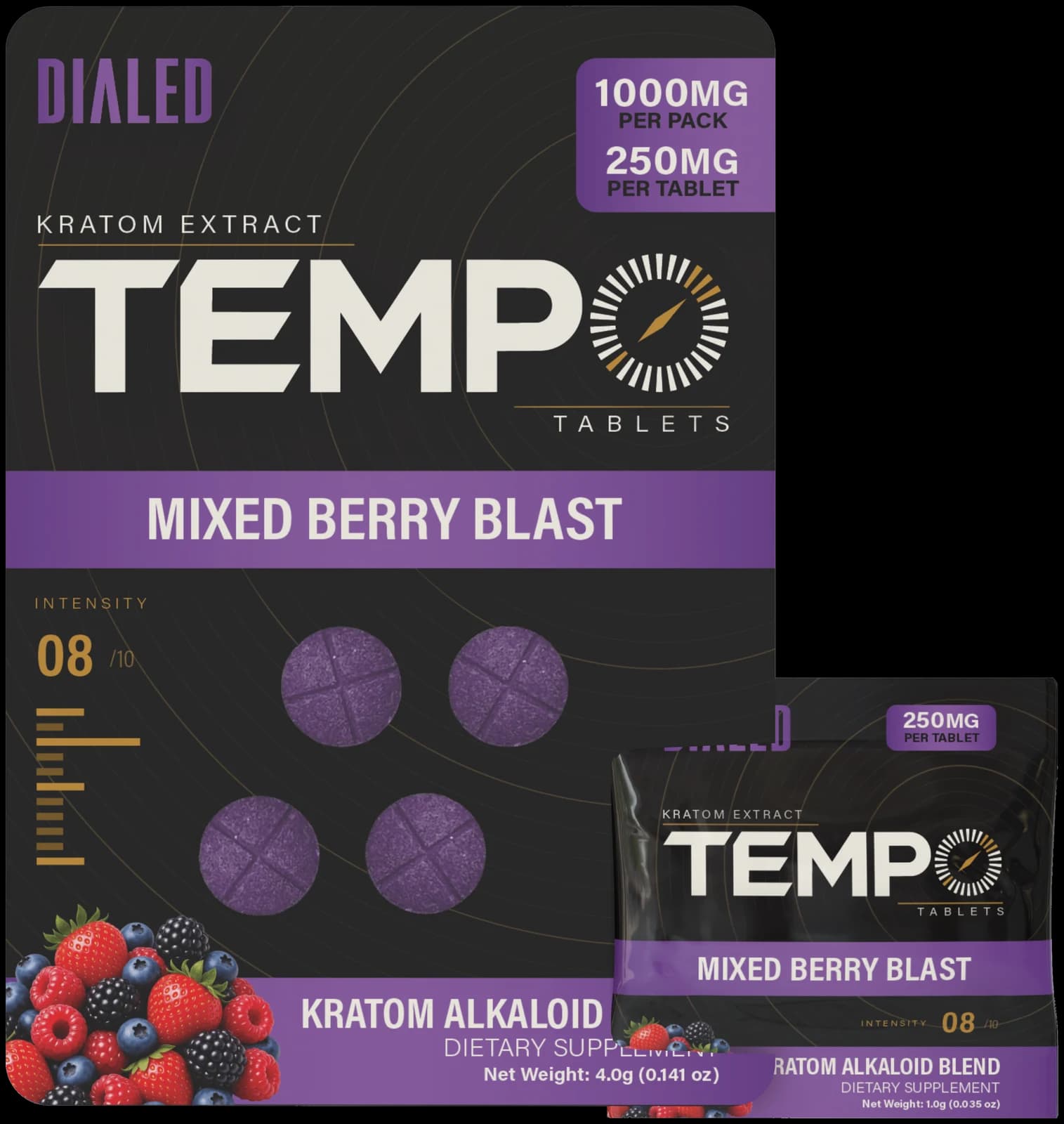
"Extract" tells you the leaf was concentrated. It doesn't tell you what was kept. A full-spectrum extract preserves the leaf's broader alkaloid profile in roughly its natural proportions; an isolate is a single compound purified away from everything else. Both can be labeled "150 mg mitragynine." They are not the same product. This article explains the difference, why it matters more since the 7-OH rule, and why Tempo is built on full-spectrum extract.
Definitions
- Full-spectrum extract: kratom leaf extracted (typically with water and/or ethanol) and concentrated in a way that carries the major and minor alkaloids together: mitragynine, paynantheine, speciogynine, speciociliatine and the trace compounds. Standardization means the extract is blended so a set amount of mitragynine lands in each serving, but the rest of the profile comes along.
- Isolate: one compound purified to high concentration, usually 90%+. Mitragynine isolate exists. 7-OH isolate was the basis of nearly every "7-OH tablet" sold in 2024–2025.
- "Broad-spectrum" or "enhanced": loosely used terms, often meaning a full-spectrum base with an added isolate. Read the label carefully; "enhanced" frequently meant added 7-OH.
How each is made
A full-spectrum extract starts with tested leaf, extracts it, removes solvent, and assays the result by HPLC. The extract is then blended to hit a target mitragynine concentration. Because the alkaloid ratios in the leaf are preserved, a full-spectrum extract at 150 mg mitragynine also delivers a proportionate amount of paynantheine and speciogynine and traces of the rest; in Tempo's case, 7-OH comes back not detected on every lot.
An isolate goes further: repeated purification (chromatography, crystallization) strips away everything but the target compound. Mitragynine isolate is a near-pure white-to-tan powder. 7-OH isolate, since natural leaf contains only trace 7-OH, was generally produced by chemically converting mitragynine, which is why it was described as semi-synthetic.
What's in the full-spectrum profile
| Alkaloid | In full-spectrum extract | In mitragynine isolate | In 7-OH isolate |
|---|---|---|---|
| Mitragynine | Primary, standardized | ~All of it | Trace or none |
| Paynantheine | Present | Removed | Removed |
| Speciogynine | Present | Removed | Removed |
| Speciociliatine | Present | Removed | Removed |
| 7-OH | Trace, must be verified under threshold | Trace or none | ~All of it (now Schedule I above threshold) |
| Minor alkaloids | Present | Removed | Removed |
Background on each compound is in Mitragynine Explained.
Why the difference is noticeable
We can't make pharmacological claims, and the research on kratom's minor alkaloids is still developing. What we can report is consistent user and formulator experience: full-spectrum extracts are generally described as rounder and more "like the leaf," while mitragynine isolate at the same milligram number reads as sharper and narrower. Whether that comes from the minor alkaloids contributing directly, from ratios, or from something else is a question for researchers; the practical observation is stable enough that most experienced formulators prefer a full-spectrum base and use standardization to make it consistent.
7-OH isolate was a different case entirely. Its profile was fast, heavy and short, with a steep tail, and it drove the 2024–2025 tablet market until scheduling. It's the reason "extract tablet" became associated with something far more intense than leaf. See 13-OH tablets vs 7-OH tablets.
Testing differences
Full-spectrum extracts are, in one respect, harder to keep compliant: concentration raises every alkaloid, including the trace 7-OH that came with the leaf. A 20x extract of leaf at 0.03% 7-OH is nominally 0.6% 7-OH before blending, well above the 0.050% dry-weight limit, which is why the finished tablet's dilution and per-unit 7-OH must be measured and verified. Dialed's COAs report 7-OH in mg per tablet and % dry weight for every lot; to date it has come back not detected.
A well-made COA for a full-spectrum product will also show the secondary alkaloids, which is a useful fingerprint: a "full-spectrum" extract whose COA shows only mitragynine and nothing else may not be what it claims. How to read those lines: our COA guide.
Why Tempo uses full-spectrum extract
Three reasons.
- Feel. We prefer the rounder profile, and it pairs better with 13-OH corydalis extract, whose role in the formula is to add fullness and reduce harshness across a full 150 mg mitragynine serving. An isolate base would have made the tablet sharper and pushed us toward even higher mitragynine numbers.
- Honesty of the "kratom" claim. A full-spectrum extract is still recognizably the leaf, concentrated. A mitragynine isolate is a single molecule; calling it "kratom" is a stretch.
- Compliance by design. Standardizing a full-spectrum extract to 150 mg mitragynine and verifying 7-OH not detected on every lot keeps the product a comfortable distance from the line rather than chasing it. That's the whole point of the post-7-OH formula. Read why the pairing works.
How to tell which one you're holding
Labels rarely say "isolate" in large type. Clues that a product is a full-spectrum extract: the ingredient line says "kratom leaf extract" or "Mitragyna speciosa leaf extract," the COA shows secondary alkaloids alongside mitragynine, and the mitragynine number is stated in milligrams with a total extract weight larger than the mitragynine figure. Clues that it's an isolate: the ingredient line names a single compound ("mitragynine 95%"), the COA shows one alkaloid and nothing else, or, for the products that are now illegal, the label advertised 7-OH by the milligram. A product that lists "kratom alkaloids" with no breakdown is telling you very little, and the COA is where to look next.
A related trap is potency multipliers. "50x extract" describes the concentration ratio of leaf to extract, not the mitragynine content, and it's not standardized across brands. A "10x" full-spectrum extract from strong leaf can carry more mitragynine per gram than a "50x" from weak leaf. The milligram number is the only one that means anything.
Which should you choose?
If you want the closest thing to leaf in a precise, portable format, a full-spectrum extract tablet is the answer. If a product is marketed as an isolate, ask which compound: a mitragynine isolate is legal but narrow; anything that's a 7-OH isolate above threshold is Schedule I as of August 5, 2026 and shouldn't be on the shelf. Either way, the same rules apply: mitragynine in milligrams on the label, a lot-specific COA, 7-OH under threshold. Dialed's Tempo 4ct blister and Tempo 1ct sachet both meet that standard, and the science page goes deeper on the formulation.
Frequently asked questions
Is full-spectrum kratom extract stronger than an isolate?
Not by definition. Strength is set by the mitragynine milligrams. Full-spectrum extracts are usually described as fuller and rounder at the same milligram number, isolates as sharper. 7-OH isolate was much stronger per milligram, which is part of why it was scheduled.
Does full-spectrum extract contain 7-OH?
It can, in trace amounts, because leaf does. Compliant products verify it stays under 1.00 mg per unit and 0.050% dry weight. Tempo adds no 7-OH, reports the number on every COA, and it has come back not detected on every lot.
What does "standardized" mean on a full-spectrum extract?
The extract is blended so each serving contains a fixed amount of the marker compound, mitragynine, while the rest of the alkaloid profile remains. It's how a full-spectrum product becomes consistent from lot to lot.
Important
These statements have not been evaluated by the Food and Drug Administration. This product is not intended to diagnose, treat, cure, or prevent any disease. Not for use by anyone under 21. Keep out of reach of children. Do not use if pregnant or nursing. Consult a physician before use if you have a medical condition or take medication. Do not operate a vehicle or heavy machinery after use. Kratom products may be habit-forming; use responsibly.
This article is for general information only and is not medical, legal, or professional advice. Kratom laws change frequently — verify current rules in your state and locality before purchasing. Tempo by Dialed does not contain added 7-hydroxymitragynine; every lot is verified below the federal threshold. Must be 21+ to purchase.
