Kratom's legal status in the United States is a patchwork: federal rules set a floor, states layer their own laws on top, and a few cities and counties go further. This guide summarizes the picture as of September 2026. It's the same information we use to decide where Dialed ships, and it comes with the caveat every honest kratom law page needs: laws change, sometimes quickly. Verify with your state and local government before buying or selling. This isn't legal advice.
Federal status first
Kratom (Mitragyna speciosa) and its primary alkaloid mitragynine are not federally scheduled. What is scheduled, as of August 5, 2026, is 7-hydroxymitragynine (7-OH) above 0.050% dry weight or 1.00 mg per unit, under a two-year temporary DEA order. Natural leaf and extracts under that threshold remain federally legal. The FDA has not approved kratom for any use and continues to warn against it; that's a regulatory posture, not a ban. Full explanation in Is 7-OH Banned?
Everything below assumes a compliant product, meaning 7-OH under threshold. Dialed verifies that on every lot's COA.
States that ban kratom
Six states prohibit kratom entirely, typically by scheduling mitragynine and 7-OH under state law:
| State | Status |
|---|---|
| Alabama | Banned (state Schedule I since 2016) |
| Arkansas | Banned (scheduled since 2016) |
| Indiana | Banned (classified as a synthetic drug) |
| Rhode Island | Banned; repeal legislation has been debated repeatedly, verify current status |
| Vermont | Banned (state regulated-drug list) |
| Wisconsin | Banned (state scheduled mitragynine and 7-OH) |
Dialed does not ship to these states and cancels orders addressed to them. Rhode Island in particular has seen active legislative efforts to replace the ban with a regulatory framework; check before assuming either way.
Kratom Consumer Protection Act states
The Kratom Consumer Protection Act (KCPA) is model legislation that, rather than banning kratom, regulates it: minimum purchase age (18 or 21 depending on the state), labeling requirements, limits on 7-OH content and contaminants, and prohibitions on adulteration. States that have passed a KCPA or similar regulatory law include, as of this writing:
- Utah (first, 2019), Georgia, Arizona, Nevada, Oklahoma, Oregon, Colorado, West Virginia, Texas, Kentucky, Virginia, Missouri, Florida, Maryland, and others; the list has grown every legislative session.
Details vary a lot. Some KCPAs set the age at 18, others at 21. Some cap 7-OH as a percentage of total alkaloids (often 2%), a standard that predates and is stricter in practice than the new federal per-unit rule. Some require registration or licensing of sellers. Florida's 2023 law, for example, sets the age at 21 and imposes labeling requirements; see our Florida guide. If you sell kratom in a KCPA state, read the actual statute, not a summary.
States where kratom is legal with no specific kratom statute
In the remaining states, kratom is legal by default: it isn't scheduled and there's no kratom-specific regulatory law, so general consumer-product, labeling and age rules apply. That includes most of the Northeast, Midwest and Mountain West. "No specific law" doesn't mean no rules; it means the rules are the ones that apply to any similar product, and it means a bill could change things in a single session.
Local bans and restrictions
Even in legal states, some localities prohibit kratom. Known examples as of September 2026:
| Locality | State | Note |
|---|---|---|
| Sarasota County | Florida | County ordinance bans kratom despite state legality |
| San Diego, Oceanside | California | Municipal bans |
| Jerseyville, Alton, Edwardsville | Illinois | Municipal bans |
| Union County and several other counties/cities | Mississippi | Patchwork of county and municipal bans |
| Denver | Colorado | Not a ban; human-consumption labeling rules |
This list is not exhaustive. Dialed's checkout flags known local restrictions and we don't ship into them. If you know of one we've missed, email compliance@feeldialed.com.
Age limits
Where states have set an age, it's 18 or 21. Dialed sells to 21+ everywhere regardless of state minimum, both because Florida (our home state) requires it and because it's the right line for a concentrated extract product. Our site has an age gate and our retail partners check ID.
Quick reference table
| Category | States (as of Sept 2026) | Dialed ships? |
|---|---|---|
| Banned | AL, AR, IN, RI, VT, WI | No |
| Regulated (KCPA or similar) | AZ, CO, FL, GA, KY, MD, MO, NV, OK, OR, TX, UT, VA, WV and others | Yes, 21+ |
| Legal, no kratom-specific statute | Remaining states and DC | Yes, 21+ |
| Local bans within legal states | See table above | No, to those localities |
What's pending and changing
Three trends to watch. First, more states are moving from "no law" to a KCPA, which is generally good for consumers because it forces testing and labeling. Second, several states are considering or have passed 7-OH-specific restrictions that mirror or exceed the federal rule. Third, a handful of states periodically consider full bans; those bills usually stall, but not always. We revise this article when something material changes, and the shipping rules at checkout are updated first.
How to verify your own state and city
- State statutes. Search your state legislature's site for "kratom" or "mitragynine." A KCPA will appear as a consumer-protection or agriculture statute; a ban will appear in the controlled-substances schedule.
- State agency guidance. Departments of agriculture, health or alcohol/tobacco control often publish plain-language summaries and retailer registration rules.
- County and city codes. Municipal code libraries (Municode and similar) are searchable. Local bans are usually short ordinances that are easy to miss unless you look.
- Pending bills. Legislative trackers show introduced bills; a ban or KCPA can move from introduction to law within a single session.
Retailers in KCPA states should also confirm whether their state requires seller registration, product registration, or specific label language beyond the federal baseline.
Traveling with kratom
Within the US, carrying a sealed, labeled, compliant product between legal states is generally fine, but don't bring it into a banned state or locality, and don't fly internationally with it; many countries prohibit kratom outright, including Thailand's neighbors and much of Europe and Australia. A labeled retail package with a lot number and a linked COA is the most defensible thing to carry.
Where to buy compliant kratom tablets
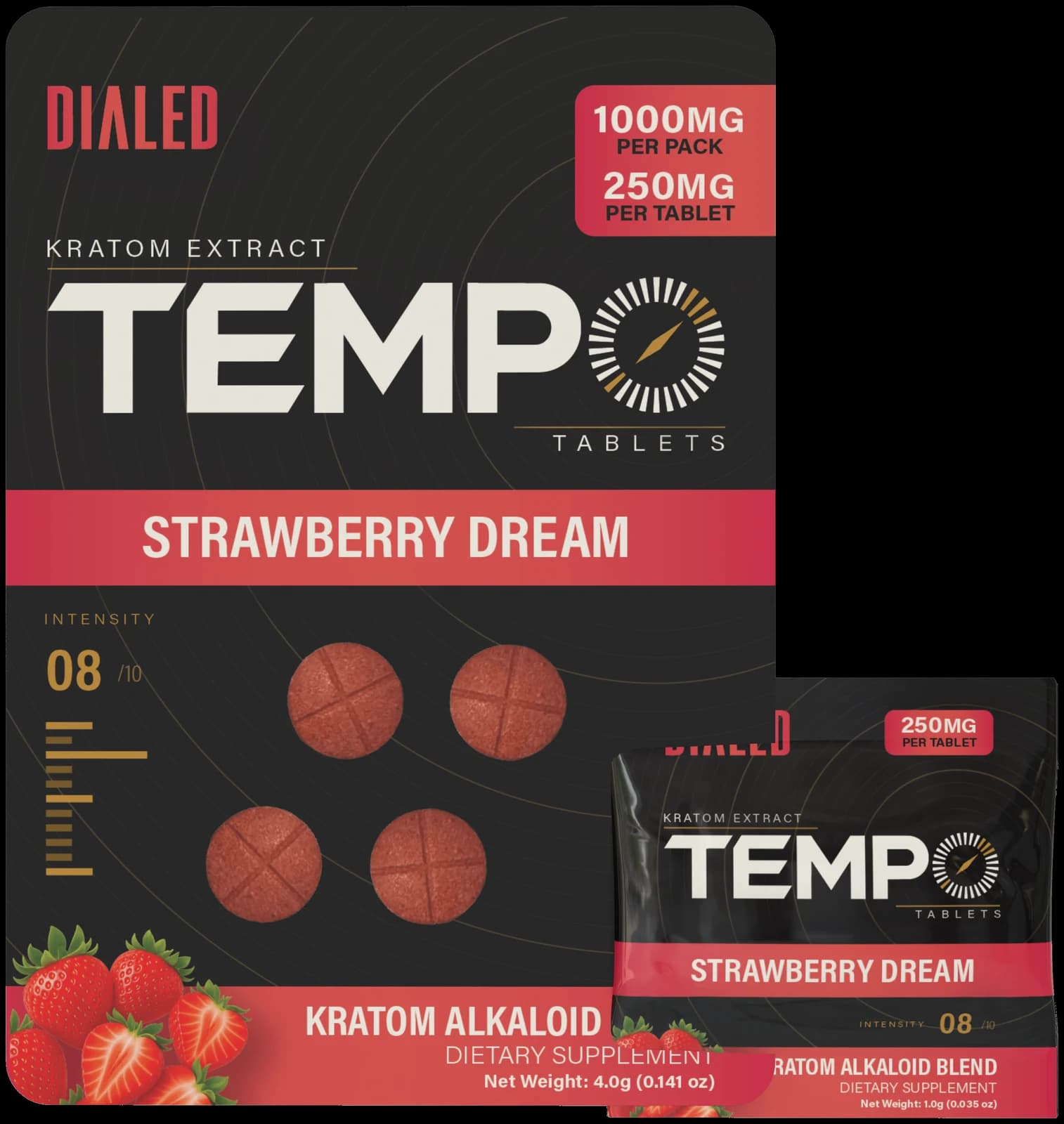
Dialed ships from Florida via USPS to every state where kratom is legal, and it's stocked by Florida smoke shops listed in the store locator. The Tempo 1ct sachet and Tempo 4ct blister both carry the lot number, 21+ mark, ingredient panel and warnings required by Florida law, which happens to satisfy most other states' labeling rules too. Shipping details are in the FAQ.
Frequently asked questions
Is kratom legal federally in 2026?
Yes, with a threshold. Kratom and mitragynine are not federally scheduled; 7-OH above 0.050% dry weight or 1.00 mg per unit is Schedule I as of August 5, 2026. Compliant products stay under that line.
Which states ban kratom?
Alabama, Arkansas, Indiana, Rhode Island, Vermont and Wisconsin, as of September 2026. Some counties and cities in otherwise legal states also ban it.
What does a Kratom Consumer Protection Act do?
It regulates rather than bans: sets a minimum age, requires labeling and testing, limits 7-OH and contaminants, and penalizes adulteration. Specifics differ by state; Florida's sets the age at 21.
Important
These statements have not been evaluated by the Food and Drug Administration. This product is not intended to diagnose, treat, cure, or prevent any disease. Not for use by anyone under 21. Keep out of reach of children. Do not use if pregnant or nursing. Consult a physician before use if you have a medical condition or take medication. Do not operate a vehicle or heavy machinery after use. Kratom products may be habit-forming; use responsibly.
This article is for general information only and is not medical, legal, or professional advice. Kratom laws change frequently — verify current rules in your state and locality before purchasing. Tempo by Dialed does not contain added 7-hydroxymitragynine; every lot is verified below the federal threshold. Must be 21+ to purchase.